
The budget is not taking us to a good place

Posted March 6, 2026
The February 23rd budget was introduced with a barrage of explanatory material. Governments provide a complex range of services, most of which require a lot of infrastructure: schools, hospitals and seniors housing, for example.
In the introduction of Minister John Lohr’s speech, he criticizes the Stephen McNeil governments’ focus on reducing financial deficits and improving fiscal balance sheets. Lohr argues that they should have been overspending to improve services.
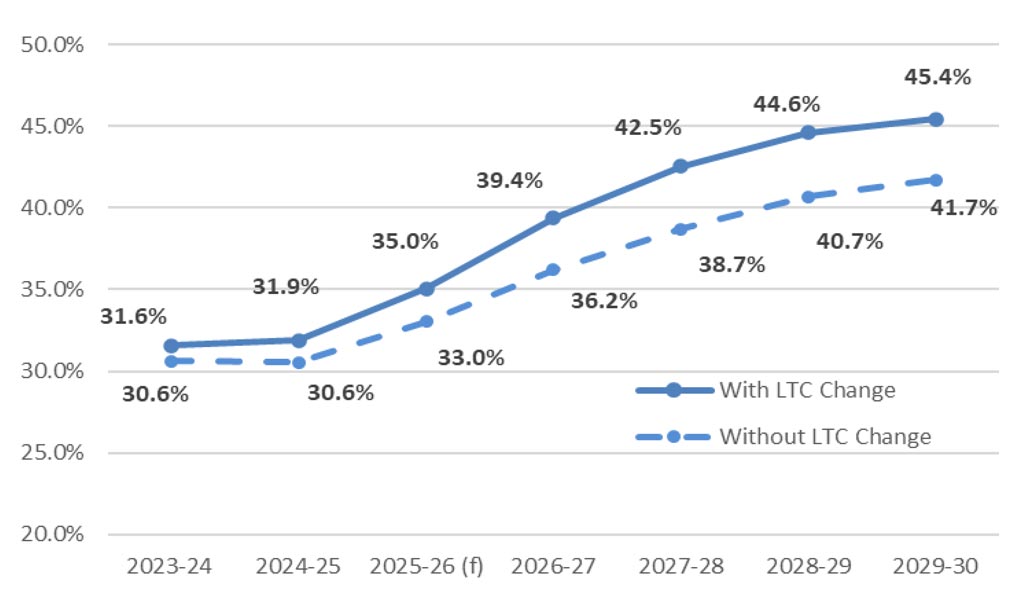
A simple projection of the province’s prospects today tells a discouraging story. (The difference between the two lines is due to an accounting change.)
Net Debt to GDP: With and Without LTC Accounting Adjustment
 (Source: Government of Nova Scotia)
Net debt is the total owed to lenders, reduced by financial assets. Gross Domestic Product (GDP) is a measure of economic activity in the province. Increases in GDP increase the taxes the province collects.
The goal for that ratio is to have it flat or decreasing. The current chart shows a 43% increase in the ratio by 2030. That means the cost of servicing the debt is growing much faster than the growth in the economy. The outcome will be worse if debt rating agencies downgrade their estimate of the province’s ability to service the debt.
The 2025-2026 budget was a big change from the previous four years, each of which delivered surpluses. The strong increase in population was an important contributor to those successes.
The government has abandoned a successful formula. Having added 100,000 Nova Scotians in the previous four years, the pace dropped to less than 5,000 in 2025. The province plans to stay below that low level.
The taxes paid by the newcomers have been a major source of the surpluses. So have the increased taxes of very busy tradespeople. As a result, the province’s tax receipts were $931 million more than anticipated in 2024-2025.
Yes, there were stresses on the housing market, but the pace of building is now adding many more units. Developers completed 9,760 units in 2025, enough to house about 25,000 people.
This is already being reflected in the upper end of the renting market. Developers are offering free months of rent or other incentives to fill up their buildings. Renters having lots of options is the best form of rent control.
There were 14,000 units under construction at the end of 2025, which should improve rental options for the middle part of the market.
The Houston plan to limit growth to 5,000 people will cause the construction pace to slow down, resulting in reductions in trades employment and reducing their contribution to taxes.
This government’s spending has substantially exceeded their budgets, adding hundreds of millions to the final outcome, more than a billion in 2025-2026.
Rather than addressing the deficits, the government has been adding new handouts. The provincial part of the HST was reduced by 1%. Several non-refundable tax credits were indexed to lower the income taxes people pay.
Indexing of tax brackets brought the province in line with the rest of Canada. Tolls on highways and bridges were cancelled. A province-wide school lunch program was created.
Given the current fiscal position, the government might wish that some of those had never happened. The only one that should not be regretted is the indexing of income tax brackets for inflation.
The theme of this year’s budget is austerity.
The core civil service is to be reduced by 5% a year for four years, saving $95 million by year four. The broader civil service will see three percent cuts.
Small museums are being shuttered. Grants to arts and community organizations are being cut by $130 million. These are devastating choices.
Meanwhile, in 2025 the government gave $69 million to the film industry, double what had been budgeted. Those grants do not create a single self-sustaining job.
The 2026-27 budget includes a $3.5 billion capital plan, focusing on public housing, schools, highways and improved hospitals.
It includes the first year of an $874 million commitment to build 5,700 new and replacement long-term care spaces by 2032. That is about $153,000 per bedroom.
The maximum charge for residents is $114 per day for nursing homes and $68 per day for residential care facilities, less for residents with incomes below $48,952.
Those payments are covering the cost of meals, with the added amount for support staff at nursing homes.
No charge is made to amortize the cost of construction, no matter how wealthy the resident. Instead, the full $874 million plus interest will be spread across all taxpayers.
The September 2025 auditor general report on the construction projects for long-term care spaces does not give reason to be optimistic.
An even more important report is due on March 31st. It will examine the massive procurements by Nova Scotia Health. The pressure to get things done quickly is likely to have weakened oversight.
The government has correctly opened the doors to exploitation of our natural resources, including natural gas, minerals, and wind. But it will be years before that turns into significant contributions to the province.
The government is spending as if those are already in place. It is ignoring the benefits of higher population growth. There needs to be a better plan and much greater discipline.
Related Articles
Budget Season- The Fraser Institute estimates of federal-provincial transfers are overstated February 20, 2026
- Nova Scotia’s billion dollar deficit is reason for worry; rigorous spending discipline is needed September 26, 2025
- Canadians need to support each other against Trump’s tariff tirade July 18, 2025
Cancel reply