
The Fraser Institute estimates of federal-provincial transfers are overstated
Posted February 20, 2026
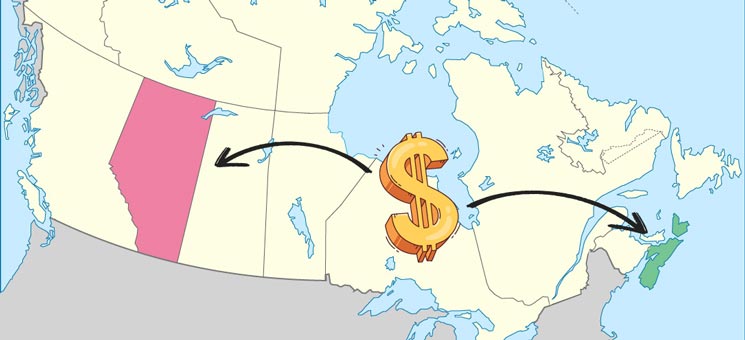
The government of Canada provides Equalization payments to provinces that are less prosperous than the average. These payments are an important aspect of federalism. The federal income tax rates apply equally to people in every province.
The intention is to help less prosperous (‘have not’) provinces to provide core services at a reasonably acceptable level. All provinces receive payments from Ottawa supporting health care and other needs.
In recent years the main beneficiaries have been Quebec and the Maritime provinces. Due to its offshore oil projects Newfoundland and Labrador is now a ‘have’ province.
Federal taxes from Alberta, Ontario, and British Columbia have been the main sources of the funds. Alberta’s taxpayers are the biggest source per person.
A report by the Fraser Institute begins with a calculation of amounts transferred to have not provinces in the years 2007-2019. To make the number bigger, they ramp prior years’ amounts up for inflation to 2018. This might be interesting for historians but is not indicative of the current situation.
The opening declaration is deeply flawed: “Equalization forms only a small part of these transfers. Consider Atlantic Canada: over the period from 2007 to 2019, Ottawa spent $423.2 billion and raised revenues of $226.5 billion for a net transfer of $196.7 billion to the region.”
The reader would infer that these numbers are about inter-governmental transfers. In fact, the amounts include defense spending, which is very small in Alberta and enormous in Nova Scotia, getting even bigger with the spending on shipbuilding. That bears no resemblance to Equalization payments.
Over the years Albertans have been unfairly treated by both Prime Ministers named Trudeau.
Pierre Trudeau showed considerable disdain for Alberta with his National Energy Program. The “Made In Canada” oil prices lowered the price of Albertan oil to below global prices.
He also made it harder for the oil companies to find and extract oil. Justin did likewise, setting up a string of regulatory hurdles that felt like crawling over broken glass.
A nascent separatism sentiment is emerging. So far, fewer than 30% of Albertans are said to be supportive. Into this sensitive context, the Fraser Institute has released a report that will cultivate grievances.
The primary irritant is the equalization program. Nova Scotia’s revenue from all sources in 2025-2026 is estimated to be $16.5 billion, of which Equalization Payments are $3.64 billion. That amounts to 21% of the province’s revenues.
Fraser infers that the Maritime provinces get more per capita then Alberta on the other federal transfers. That is not the case for Nova Scotia.
In the current year, Alberta is receiving $13.3 billion, which is $2,640 per person. Nova Scotia’s transfers other than Equalization were $2.76 billion, which is $2,520 per person.
Canada’s unemployment insurance program charges the same rate for workers in every province.
The Fraser report argues that the program is another subsidy from Alberta to other provinces on the grounds that Alberta’s rate of unemployment is lower, resulting in fewer claims.
That is not the case. Nova Scotia’s unemployment rate in December was 6.5% while Alberta’s was at 6.8%. In October, Nova Scotia was at 6.7% while Alberta was at 7.8%. Nova Scotia has been subsidizing Alberta.
Notwithstanding obstacles from Trudeau, the government of Alberta forecasts $16.9 billion of bitumen royalties and $4.6 billion of revenue from other resources in the current fiscal year, amounting to $4,300 per person. That is what makes it possible to have income tax rates lower than the other provinces, and no provincial sales tax.
Some Nova Scotians who are commuting to Alberta moved back from there years ago and retained their Albertan residences. That makes it possible to manage occupancy so as to pay provincial taxes in Alberta rather than Nova Scotia. That saves about them about $6,000 a year.
Alberta does not pay for their Nova Scotian family’s schools and health care. And the federal tax is counted as being from Alberta.
All that said, Nova Scotia needs to better take advantage of its assets. Prime Minister Carney and Nova Scotia Premier Houston have made important changes in policy.
Carney’s Building Canada Strong program invigorates major projects across the country. In particular, it takes off the handcuffs and champions another oil pipeline through British Columbia.
Houston understands that Nova Scotia must exploit its own resources, both for employment and to reduce the need for Equalization payments.
Mining for minerals, including uranium, and fracking for natural gas are viable sources. These are safely extracted in other parts of Canada. Other countries wanting to reduce carbon-based electricity will need uranium for nuclear power.
Multiple wind farms will provide domestic electricity and exports of green hydrogen. The pace of announcements is encouraging, especially for thinly populated counties such as Guysborough.
If and when the day comes when Nova Scotia becomes a have province, we should be glad that some of the taxes we pay to Ottawa will be used to support Canadians who are less prosperous.
Related Articles
Budget Season- The budget is not taking us to a good place March 6, 2026
- Nova Scotia’s billion dollar deficit is reason for worry; rigorous spending discipline is needed September 26, 2025
- Canadians need to support each other against Trump’s tariff tirade July 18, 2025