
Premier Houston’s next budget must be more rigorous
Posted October 16, 2026
Premier Houston has invited Nova Scotians to provide advice on future budgets. Your columnist is glad to participate.
Some premiers of the past have focused on fiscal discipline, with surpluses or very small deficits. Others have thrown caution to the wind.
John Hamm (premier August 1999 to February 2006) made good progress in managing the province’s books. Rodney MacDonald (to June 2009) and Darrel Dexter were less competent.
Stephen McNeil, elected in October 2013, was much stronger, providing five consecutive balanced budgets ending in 2021. His successor, Iain Rankin, was not able to retain power for the Liberals.
Tim Houston was elected in August of 2021. Since then, he has benefitted from the strong fiscal base that McNeil built. An added contribution was 100,000 new tax-paying residents in the four years ending Jan 1, 2025.
Houston’s foremost promise in the 2021 election was to “fix health care.” That was bound to require a lot more money.
It did not discourage him from a pile of giveaways and investments sure to please:
- Free parking at hospitals
- Tolls on highways and bridges were cancelled, notwithstanding a needed repair or replacement of the MacKay bridge, expected to cost up to $3 billion.
- 10% rebates on home heating
- Faster highway upgrades
- Income tax brackets increased with inflation, as happens in other provinces
As a result, Nova Scotia will have a deficit exceeding $1.4 billion in the current year, adding considerably to the future interest payments to lenders. The debt is predicted to grow by $7.9 billion in the three years ending 2029-2030. Hospital construction projects add more than $3 billion to the debt.
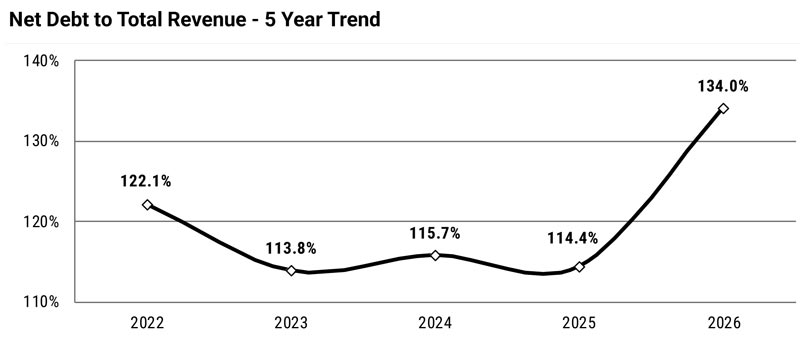
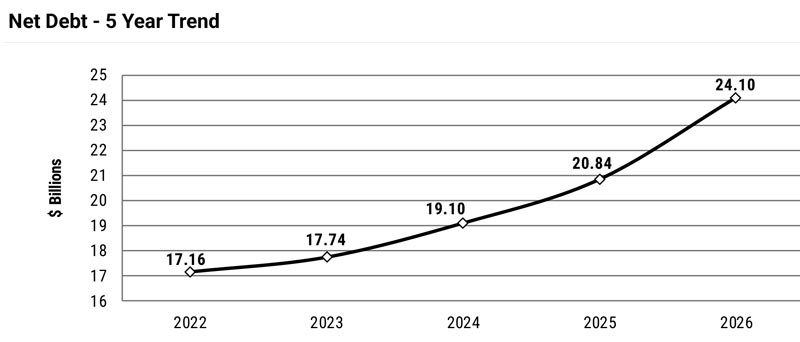
Source: Public Accounts: Volume 1 — Consolidated Financial Statements for the fiscal year ended March 31, 2026 (Province of Nova Scotia)
Lenders depend on rating companies to evaluate the province’s ability to make their payments. Low credit ratings will increase the interest rates on provincial debt.
Three of the rating companies provide ratings for Nova Scotia. Dominion Bond Rating Service rates Nova Scotia at A, its third-highest level. Moody’s recently reduced their rate to Aa2, also its third level. Standard & Poors published the headline: “Province of Nova Scotia Downgraded To ‘A+’ From ‘AA-’ on weaker Budgetary position; Outlook Remains Negative.”
Clearly this is going in the wrong direction.
Here are some suggestions:
- Undo most of the giveaways:
- The federal government has announced a $2 billion National Heat Pump Rebate program that offers up to $10,000 for eligible low-to-median-income households and up to $2,000 for other eligible homeowners. That can replace Nova Scotia’s rebate.
- Hospitals should charge for parking for visitors, not for staff.
- Slow down the pace of highway improvements. No new hospital projects should be commenced until the existing ones, including the Infirmary project, are completed.
- Tolls should be reinstated for highways and most bridges
- The heavily subsidized Yarmouth Ferry is an American boat with an American crew. If it was not there, most of the passengers on it would come to Nova Scotia by other means. It facilitates Nova Scotians spending their travel dollars in Maine instead of home. Make this the last year for the Yarmouth Ferry. The taxes the province receives because of the Yarmouth Ferry do not validate the subsidy.
- In 2026, performing artists working year-round had their support from the government severely cut. In 2025, the government gave $69 million to the film industry, double what had been budgeted. Those grants do not create a single self-sustaining job. Cancel them.
Premier Houston has been promoting Nova Scotia’s strong prospects. They include:
- Opportunities for mining many metals, including gold and uranium. Yarmouth County contains significant mineral potential, particularly for critical and rare metals.
- Opportunities for natural gas, including the possibility of fracking.
- Opportunities to capture and export power from wind turbines on land and in the water.
Each of these can happen without government capital. They all will provide substantial contributions to the government’s income.
At the same time there are strong opportunities in the defense industry, especially submarines. All of these will involve lots of high-paying jobs. Many of them will come from outside the province.
Population growth was very important to the strength of the economy in the five years ending in 2025, and that growth continues. Nova Scotia grew by 8,000 people in the 12 months ending July 1, 2026. That pace will continue if the economic opportunities are realized.
These are reasons to be hopeful about the future strength of Nova Scotia’s economy. But disappointments are certainly possible. None of the prospects for growth is a sure thing. In the meantime, greater financial discipline is essential.